

By Supan Chakma
The Buddhist indigenous communities of Bangladesh have decided not to hold the Kathin Chibor Daan ceremony this year. The Chittagong Hill Tracts, located in the southern part of Bangladesh, is a mountainous region where 11 different indigenous groups have lived for centuries. Notably, more than 900,000 indigenous Buddhists reside in the three districts of the Chittagong Hill Tracts. On September 19-20, Bengali settlers carried out communal attacks on the indigenous Buddhists in the region. In two districts, four indigenous students lost their lives, and hundreds were injured or shot. In separate incidents across these districts, the homes of indigenous people were burned, Buddhist statues were set ablaze, and monasteries were vandalized and looted.
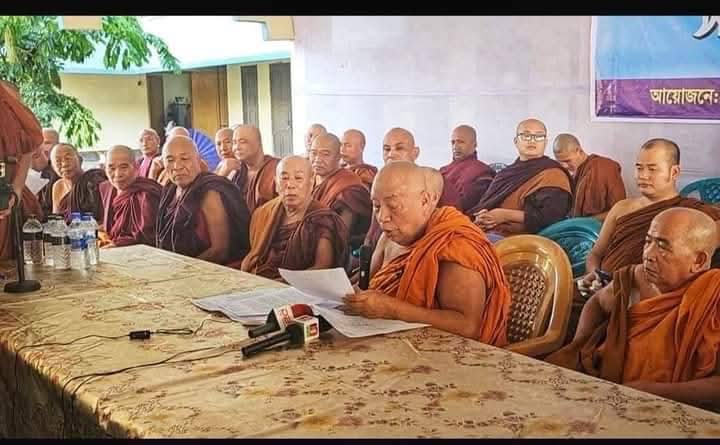
In response, Buddhist leaders and civil society members have accused the administration of not remaining neutral, claiming that the authorities indirectly and directly assisted the Bengali settlers. On Sunday at 2 p.m., a press conference was held at the Maitree Bihar in Tabolchhari, Rangamati, organized by 15 Buddhist religious leaders. Venerable Sraddhalankar Mahathero, president of the Hill Tracts Bhikkhu Sangha, stated that recent communal violence in Khagrachari and Rangamati districts resulted in attacks on monasteries, vandalism, looting, and the killing of four indigenous people. He further asserted that these incidents were aided by the administration, leading to a loss of trust and growing fear among the Buddhist followers in the Hill Tracts. He added that due to the current atmosphere of insecurity, they have decided not to hold the significant religious event of Kathin Chibor Daan. Many believe the Buddhist community is facing a future filled with uncertainty and fear.
The situation escalated after the fall of Sheikh Hasina’s government on August 5, followed by the formation of an interim government by anti-discrimination student and public groups. This new government, led by Nobel laureate Dr. Muhammad Yunus as the chief advisor, is being administered through an advisory council. Since his appointment, members of the previous government have been arrested or marginalized. The new government announced reforms in six key areas, one of which is the sacred constitution. In response, hill student groups have been organizing democratic movements in the Hill Tracts, demanding that their indigenous identities be recognized in the constitution. The hill students believe that this new government aims to erase their indigenous identity by forcibly labeling them as Bengalis, and they also suspect that there are plans for new illegal Muslim Bengali settlements in the region.
On September 18, in response to these concerns, the hill students organized a massive rally titled “March for Identity.” The primary goals of this march were to ensure recognition of each indigenous community’s identity, declare the hill districts as indigenous areas, uphold the 1900 British Government Resolution, and fully implement the 1997 Peace Accord between the indigenous people and the Government of Bangladesh. They also highlighted that indigenous people are becoming a minority in their own land and must therefore retain control over their land. Shortly after the “March for Identity,” communal attacks were carried out on the indigenous population.
The situation in the hills remains tense. Hill people claim that the government has failed to apprehend the perpetrators thus far. Additionally, the government has imposed a tourism ban for the month of October. As of now, the indigenous communities continue to live under a cloud of uncertainty.
 Chakma Digital Library